Low Kicks: How They Break a Stance
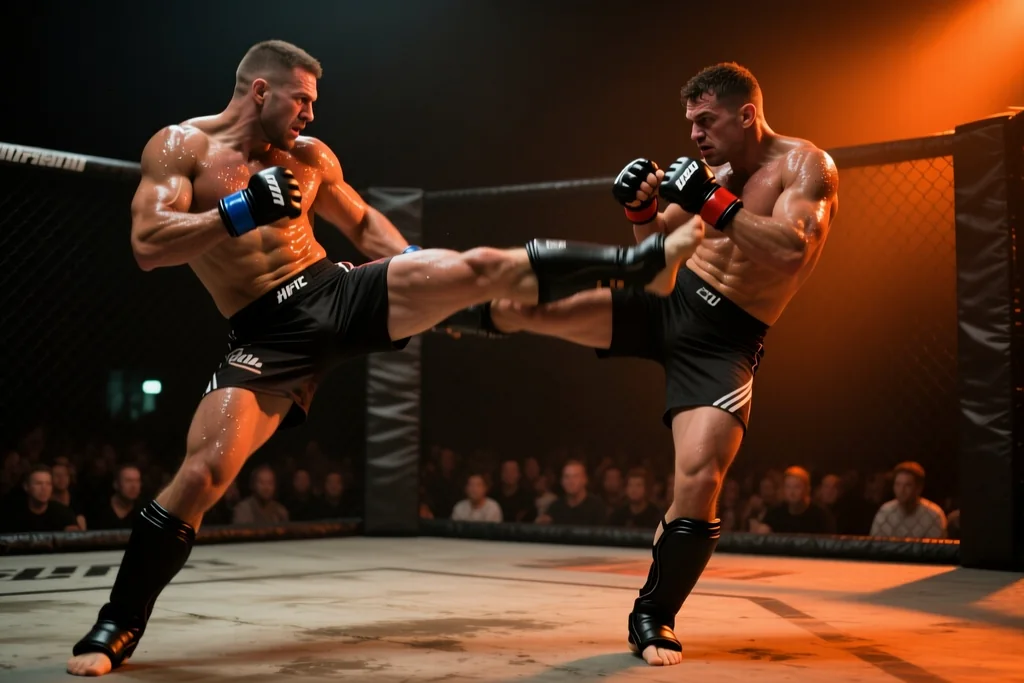
A low kick looks like the least sophisticated strike in the sport. There is no spin, no head movement, no highlight reel, just a shin meeting a leg. Then you watch a fighter lose his balance on a limb that has been chewed for two rounds, and the low kick MMA game starts to make perfect sense.
Low kicks are a movement weapon. They do not have to knock anyone out; they have to take away the base, and once the base is gone everything else in the fight gets easier.
The low kick is a movement weapon
Every fighter builds his game on his legs. He steps in to punch, he circles out of danger, he changes levels to shoot, and every one of those movements starts with a healthy leg and a confident plant.
A low kick attacks that assumption directly. The shot does not need to hurt badly on its own; it needs to make the next step hesitant, and hesitation at range is a target you can hit again and again.
That is why coaches treat low kicks as an investment. You throw them early, sometimes eating a counter to land one, because the payoff arrives later when your opponent's footwork quietly stops working.
Where to land it
The low kick MMA arsenal is not one technique with one target, and choosing the wrong line at the wrong moment wastes the shot. Each part of the leg offers a different way to take something away.
| Target | What it takes away | Best moment to throw it |
|---|---|---|
| Outer thigh | Base and the confidence to plant the lead foot | As he steps in behind his jab |
| Inner thigh | Stance width and the ability to change levels | After he settles weight on the lead leg |
| Calf, low on the shin | The push-off that starts every single step | While he is picking the foot up to move |
| Lead shin, on the check | His kicking rhythm, if you time the collision | The instant he commits to his own low kick |
The thigh lines are the classic education of Muay Thai, and they still work because the thigh is thick and the price of a miss is low. The calf shot is the modern favorite: it travels less, lands lower, and one solid connection can leave a fighter limping for the rest of the round.
Whichever line you pick, kick with the shin and not the foot, and step off the center line as you land. Kicking down the middle leaves you square, balanced and available for whatever counter he has waiting.
The check that decides the fight
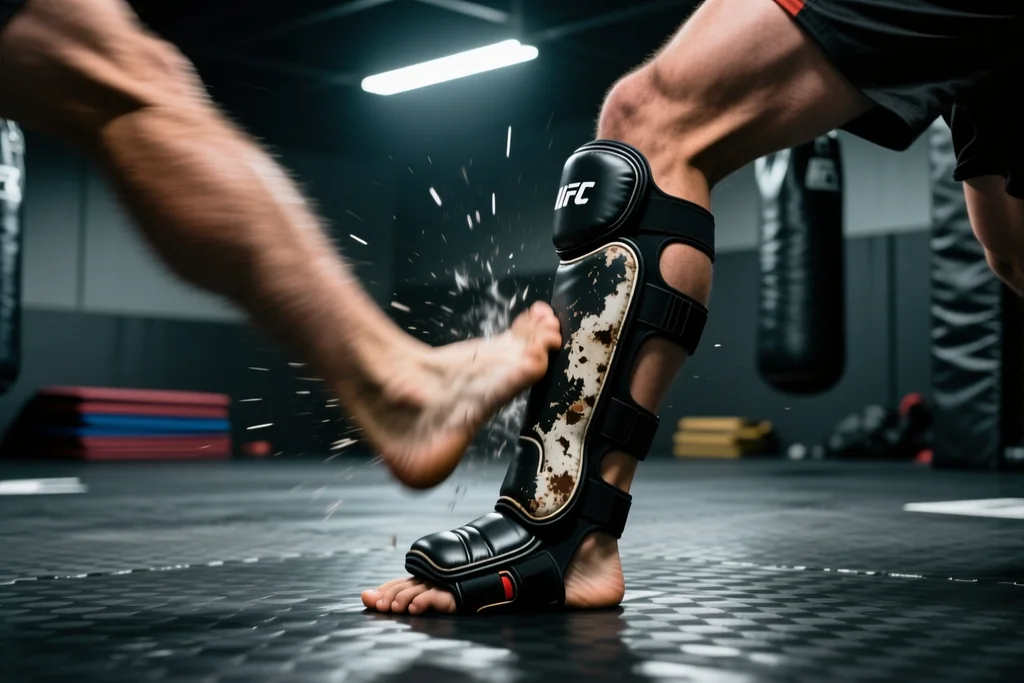
The first time two shins meet, the fight tells you who is going to keep kicking. Checking means lifting the near knee and turning the shin outward so his leg crashes into bone instead of meat.
Foot position is where people get hurt. Block with the top of the foot or a lazy toe and the impact travels into your ankle; lift the knee properly, keep the toes turned down, and the hard edge of your shin takes the collision instead.
The second consequence is psychological. Once a kicker feels his own shin bounce off a check, he starts hunting for other targets, and a fighter who is choosing instead of committing throws much weaker kicks.
Defending without checking
Checking is the cleanest answer, but it is not the only one, and against a heavy kicker it is not always the smartest. Sometimes the better defense is to make the kick land on empty air.
- Pull the leg back so the shin sweeps through nothing at all.
- Step in and clinch on the moment of impact, before the leg returns.
- Catch the leg and dump him, if your timing and wrestling are ready.
- Circle away from the kicking leg instead of standing in front of it.
Each of those options carries a price. Pulling back gives up ground, stepping in puts you in punching range, and catching a leg only works against an opponent who is not waiting for you to try it.
The one answer that never works is standing flat and watching the kick arrive. That is how legs get chewed up in the first place, one slow round at a time.
Low kicks and the takedown threat
Every low kick is thrown on one leg, and every opponent who can wrestle knows it. The moment you commit to the kick you are one step away from being caught and put on the fence or flat on your back.
The defense runs the other way too. A checked low kick is one of the best entries in the sport, because the kicker's weight is on his back leg and both of his hands are out of position.
That tension is what makes low kick MMA rounds so tactical. You want to kick often enough to break the stance, but never so predictably that he starts timing your kick as his way in.
Making it a weapon in the gym
Do not learn the low kick by trying to kick hard on day one. Start on the bag with a short step, land with the lower shin, and repeat until the movement is boring, because that is the version you can trust in a fight.
Then add the check drill. One partner kicks on a rhythm, the other checks and counters, and neither of you is allowed to stand flat. Ten minutes of that teaches more than an hour of watching technique videos.
The fighters who win with low kicks are rarely the ones with the hardest kick. They are the ones who kept their own leg under them while taking the opponent's base away, one boring shot at a time.