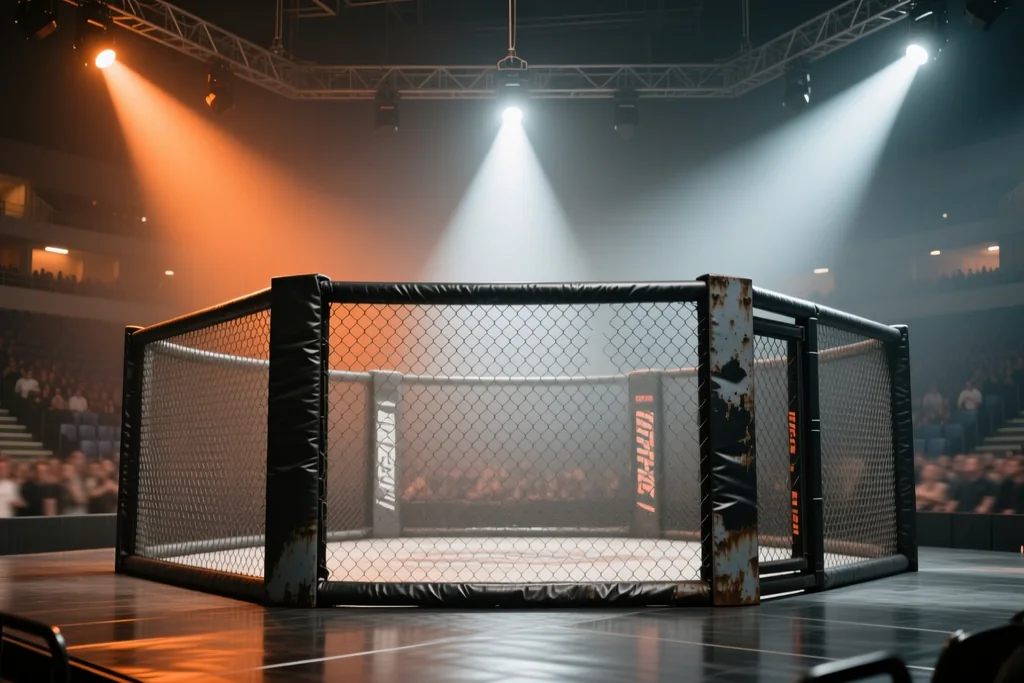
UFC 333: Volkanovski vs. Evloev in Abu Dhabi

UFC 333 takes a featherweight title fight to the Etihad Arena in Abu Dhabi on 24 October 2026, with Alexander Volkanovski defending the belt against Evloev. It is the second of the promotion's three autumn numbered events and the only one staged outside the United States.
Title fights are the easiest bouts to preview badly, because a champion's record tells you what he has already done rather than what he can still do. The more useful questions are about range, the age of the division and how many rounds the challenger believes he can win.

The card at a glance
The fixed details of UFC 333 are worth pinning down before the tactical discussion, since a title fight abroad changes both the crowd and the viewing time for anyone following from home.
| Detail | UFC 333 |
|---|---|
| Event | UFC 333 |
| Date | 24 October 2026 |
| Arena | Etihad Arena |
| City | Abu Dhabi, United Arab Emirates |
| Main event | Volkanovski vs Evloev |
| Division | Featherweight (145 lb) |
Everything that follows is reading rather than reporting. The belt, the date and the venue are settled, and the only genuinely open question is how the fight gets contested once the cage door closes.
Volkanovski and the reach question
Volkanovski stands 5 ft 6 in and weighs 145 lb, and he has held the featherweight title since 12 April 2025 with one successful defence of it. The number that matters most, though, is his 71.5-inch reach, which is unusually long for a frame that size.
That combination is awkward for opponents. A shorter fighter normally has to close distance before he can land, yet Volkanovski can strike at range while also working inside the pocket, so a challenger cannot simply hold him at the end of a jab and coast.
In MMA the reach advantage is generally treated as more important than height in a striking exchange, because it decides who lands first when both fighters commit at the same moment.
The challenger's route to an upset
Every title fight has a blueprint for the underdog, and it almost always begins with removing the champion's preferred distance. If Evloev can turn the fight into a close-quarters contest, he takes the reach out of the equation completely.
That means pressure without recklessness, entry attempts that do not leave him exposed, and an ability to keep the champion's back against the fence for long enough to bank rounds. It is a demanding plan over five rounds against a fighter who has been here before.
The alternative route is patience at range, which is harder against a champion with the longer arms. Fighting on the outside against a longer opponent usually means absorbing more shots than you land, and that is a poor trade unless the cleaner work is clearly yours.
Between those two plans sits the most realistic version of an upset: mixing pressure with short bursts of range work so the champion never settles into a rhythm. That requires a fighter comfortable switching approach mid-round, which is a rare skill at any weight.
What one title defence tells you
A single successful defence is a small sample, but it is not meaningless. It shows the champion can win a fight at the top of a card with the belt already on him, which is a different psychological task from chasing a title.
It also tells the division something about the champion's durability. Featherweight has stayed competitive because the gap between the champion and the contenders is narrow, and a narrow gap means every challenger arrives with a real route to victory.
Abu Dhabi and the five-round problem
Holding a title fight overseas adds variables that have nothing to do with technique. Travel, an unfamiliar schedule and a crowd that will not be neutral all change the rhythm of a fight camps spend months preparing for.
Over five rounds, though, the deciding factor is usually conditioning rather than atmosphere. Fighters who have never been past three rounds can look excellent early and then lose the fourth and fifth simply because they have no reference point for how those rounds feel.
What to watch when the cage closes
A title fight can be read in real time once you know which details actually shift the result. Four of them matter more than the rest.
- Who steps forward first in the opening minute, because that sets the distance for the round.
- Whether the champion can land cleanly while moving backwards, which is the hardest skill in the sport.
- How many entry attempts the challenger needs before one succeeds, since repetition is a cost in a five-round fight.
- Which fighter is breathing harder at the end of round three, because featherweight fights often turn there.
Track those four and the scorecards rarely come as a surprise, even when the fight itself is messy.
How the night is likely to be decided
The fight will most likely be settled by one of two patterns. Either the champion keeps the bout at range, wins the exchanges cleanly and defends the belt on points, or the challenger turns it into a grinding, close-range fight and steals rounds through control.
There is no way to know which version arrives until the first bell, and that uncertainty is exactly why UFC 333 is worth watching on 24 October 2026.